


There is a particular sound a gummed paper tape dispenser makes when everything is set up correctly: a short feed, a quiet cut, and the tape coming away damp but not dripping. When something is off, the sound changes — the cut drags, the tape curls, or the operator pulls twice because the first strip did not wet properly. Those small signals are the most honest indicator of whether a dispenser will hold up over a year of daily use.
This guide is written around those signals: what a gummed paper tape dispenser actually needs to do well, where stations typically go wrong, and how to evaluate a machine before committing to it.
The core mechanism, and why it rewards setup
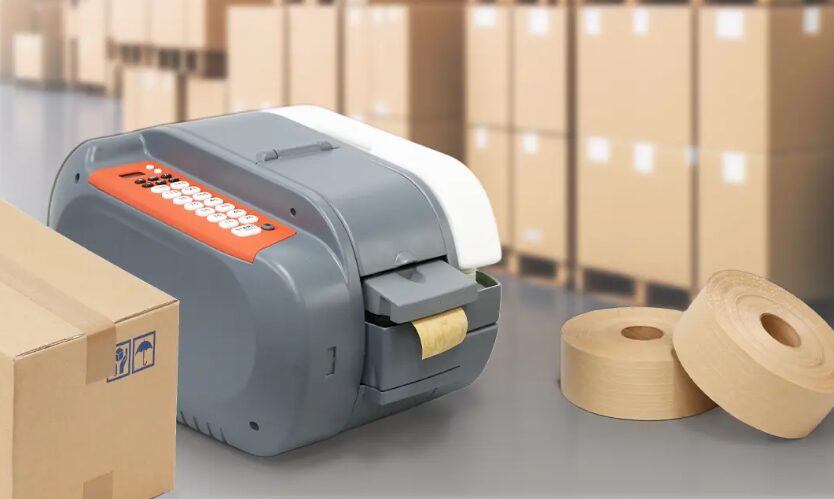
A gummed paper tape dispenser feeds kraft paper tape, passes the adhesive side over a moistening brush or roller, and cuts the strip to length. The starch-based adhesive activates on contact with water and then bonds into the surface fibers of corrugated board as it dries. This is fundamentally different from plastic packing tape, which relies on a pressure-sensitive adhesive that sits on top of the surface.
That difference explains the security benefit that drives most purchases: once a water-activated seal dries, opening the carton tears the board surface, so it cannot be resealed without visible damage. It also explains why setup matters so much. A plastic tape gun tolerates a badly positioned roll; a gummed paper tape dispenser does not, because wetting has to be consistent across the full tape width for the bond to form evenly.
Wetting is the variable that decides everything
If one factor separates reliable stations from frustrating ones, it is moisture control. Under-wetting leaves adhesive that never fully activates, so the tape lifts at corners a day later — often after the shipment has left. Over-wetting makes the tape limp, causes wrinkling on application, and extends drying time.
Practical habits that keep wetting consistent:
Heat the water. A heated tank that reaches temperature quickly supports steady activation through a shift. A 1-liter capacity is workable for most mid-volume stations without constant refilling.
Clean the brush at the end of every shift. Dried starch on the brush is the leading cause of uneven adhesion, and it develops quietly over two or three days before showing up as failures.
Use filtered water where supply is hard. Mineral buildup affects heated tanks and, over months, changes how evenly the brush wets.
Check blade condition weekly. A dull blade compresses rather than cuts, which distorts the tape edge and interferes with a clean bond.
Matching the dispenser to the station, not the catalogue
The most common purchasing mistake is buying above the station’s actual rhythm. Useful reference points from working with packing operations:
Manual lever dispensers suit operations sealing under roughly 100 cartons daily. No power, portable between stations, direct operator control. A model such as the NT-800 fits this profile with consistent moistening and simple operation, and works well as a first step away from plastic tape.
Electric automatic dispensers justify their cost once a team consistently seals several hundred cartons a day. Preset lengths and a heated tank remove the measure-and-cut step from each box. Units operating below 70 dB are easier to place on a busy floor without disrupting the workspace.
Sensor-operated dispensers dispense tape as a hand or carton passes the sensor, which reduces contact with shared surfaces and keeps high-throughput lines moving. Dispensing speeds around 60 m/min are achievable on some units, though real output depends on tape width, carton size, and station layout.
Handheld units remain the right choice for mobile packing and field service work where portability matters more than volume.
Tape compatibility deserves a full-roll test
A dispenser is only as good as the tape it is paired with. Confirm supported roll width and diameter, then run a full roll of your intended gummed paper tape through the machine — not just the sample. Wetting problems often appear partway through a roll rather than at the start. Tape stored in humid warehouses can also behave differently from tape tested in a dry office, so test under conditions that resemble your actual storage.
Sourcing dispensers and compatible water-activated kraft tape from one supplier simplifies this matching. Airpowerpak (YJNPACK) supports both, along with OEM/ODM customization such as logo printing, body color, and function adjustments for distributors building a product range.
Five checks before placing an order
Average daily volume and peak-hour volume — both matter; peak throughput often decides whether automation pays.
Tape compatibility — roll width, diameter, and a full-roll test with your own tape.
Functions actually used — manual, preset, automatic, or sensor; skip features the workflow will not touch.
Maintenance access — water refill, brush cleaning, blade replacement, and spare parts availability.
Supplier support — warranty, technical support, and customization options for resale buyers.
Where a gummed paper tape dispenser fits best
These systems deliver the most value in e-commerce fulfillment, third-party logistics warehouses with multiple packing stations, export packing where tamper evidence is specified, and cold-chain operations where plastic tape can lose adhesion at low temperatures. For operations sealing a handful of boxes weekly, a handheld dispenser is sufficient and an automatic machine is overcapitalization.
The most dependable way to decide is a trial on your own carton mix: request samples, run them through a normal shift, and listen for those small signals — the drag, the curl, the double pull. They will tell you more about the right gummed paper tape dispenser than any specification table.